
Why Companies Struggle to Find the Right Talent Despite More Applications
AI Strategy Is Also a Workforce Strategy
For U.S. businesses, adopting artificial intelligence is no longer just a technology decision. It is a workforce decision that affects how teams operate, which skills organizations need, how work gets distributed, and where future hiring investments should go.
As companies introduce generative AI, intelligent automation, predictive analytics, and AI-enabled applications, the question is changing. It is no longer simply whether an organization should adopt AI. It is how to prepare its workforce to use these technologies effectively while maintaining productivity, accountability, and business continuity.
Some tasks may become automated. Others may become faster or more analytical. Entirely new responsibilities may emerge around AI implementation, data quality, cybersecurity, governance, and human oversight. At the same time, employees in existing roles may need new technical capabilities without necessarily needing to change jobs.
For business leaders, this creates a strategic challenge: How do you build the workforce your business will need next without overlooking the talent you already have?
The answer requires a more integrated approach to workforce planning, combining skills assessment, employee development, strategic hiring, and flexible talent models.
The Numbers Behind the AI Workforce Shift
The scale of anticipated workforce change makes this a priority for business leaders, not simply a future consideration.
According to the World Economic Forum’s Future of Jobs Report 2025, employers surveyed across 55 economies expect structural labor-market changes to affect 22% of today’s jobs by 2030. The report projects 170 million jobs created and 92 million displaced globally, resulting in a net increase of 78 million jobs. It also estimates that 39% of workers’ existing skill sets could be transformed or become outdated between 2025 and 2030. These are global projections, not U.S.-specific forecasts.
U.S. employment projections also point to substantial differences in demand across occupations.
The U.S. Bureau of Labor Statistics (BLS), in its July 2026 analysis of employment projections for 2024–2034, reports that:
- Data scientists: Employment is projected to grow 33.5%, adding approximately 82,500 jobs.
- Information security analysts: Employment is projected to grow 28.5%, adding approximately 52,100 jobs.
- Software developers: Employment is projected to grow 15.8%, adding approximately 267,700 jobs.
- Customer service representatives: Employment is projected to decline 5.5%, representing approximately 153,700 fewer jobs.
For comparison, total employment across all occupations is projected to grow 3.1% over the same period. These projections reflect broader occupational trends and should not be interpreted as proof that AI alone will cause every increase or decline.
The commercial implication is significant. Demand is not moving uniformly across the labor market. Businesses may need to expand their technical capabilities while redesigning selected workflows and helping existing employees adapt to changing responsibilities.
The challenge is to anticipate those shifts early enough to make informed talent decisions.
1. AI Is Changing Jobs, Not Just Creating New Ones
One of the biggest mistakes organizations can make is treating AI workforce planning as a list of new job titles to recruit.
AI changes the content of work as well as the demand for specialized talent.
A finance professional, for example, may use AI to organize information, identify anomalies, prepare initial reports, and accelerate routine analysis. The employee’s value increasingly lies in interpreting results, validating assumptions, identifying risks, and explaining the implications to business stakeholders.
Similarly, a software developer may use AI coding assistants to accelerate parts of development, while spending more time reviewing generated code, testing system behavior, addressing security concerns, and making architectural decisions.
In recruiting and talent acquisition, AI may help organize candidate information, support job-description development, or streamline administrative tasks. Human judgment remains important when evaluating relevant experience, communicating with candidates, assessing role fit, and making fair hiring decisions.
The pattern is consistent across many knowledge-based functions: certain tasks may become easier to automate or augment, while other responsibilities become more important.
This distinction matters because jobs are made up of tasks, and tasks do not all change at the same rate.
A role-by-role review can reveal opportunities to improve productivity without assuming that an entire position should be eliminated or redesigned.
For employers, the practical question is not simply, “Which jobs can AI replace?” It is, “How will AI change the work our employees perform, and what capabilities will they need to perform it well?”
2. Which AI-Related Skills Will U.S. Businesses Need Next?
The workforce implications of AI extend beyond hiring machine learning engineers or data scientists. Organizations also need people who can integrate AI into existing systems, interpret its outputs, manage its risks, and translate technical capabilities into business results.
The BLS projections and broader employer research point to several important skill areas.
AI, data, and analytics
As businesses adopt AI-enabled tools, they need employees who understand data quality, analytics, model performance, and how to use AI-generated insights in business decisions.
Relevant roles may include data scientists, data engineers, machine learning engineers, AI engineers, and business intelligence analysts. Depending on the organization’s needs, employers may also benefit from business analysts who can connect data insights with operational priorities.
Software development and systems integration
AI solutions rarely operate independently of the rest of the technology environment. Businesses need professionals who can integrate AI capabilities with enterprise applications, cloud platforms, databases, and existing workflows.
Software developers, cloud engineers, systems architects, and integration specialists can help organizations move beyond isolated experiments toward solutions that fit their operational requirements.
Cybersecurity, governance, and risk management
As AI tools gain access to business information and become embedded in workflows, organizations must consider data privacy, access controls, intellectual property, regulatory requirements, and output accuracy.
Cybersecurity professionals, data governance specialists, risk analysts, and compliance professionals will remain important to building reliable AI-enabled operations.
AI fluency across business functions
Not every employee needs advanced technical expertise. However, many employees will benefit from understanding how to use approved AI tools, validate outputs, protect confidential information, and identify tasks where AI can add value.
For example, an HR professional may use AI to support workforce reporting, while a finance employee may use it to organize information for analysis. In both cases, understanding the technology’s limitations is as important as knowing how to use it.
The World Economic Forum identifies AI and big data, cybersecurity, and technological literacy among the fastest-growing skill areas through 2030. It also emphasizes analytical thinking, creative thinking, resilience, and adaptability.
The takeaway for employers is clear: technical expertise will matter, but so will the ability to apply it within real business environments.
- Reskilling or Hiring? Choosing the Right Workforce Strategy
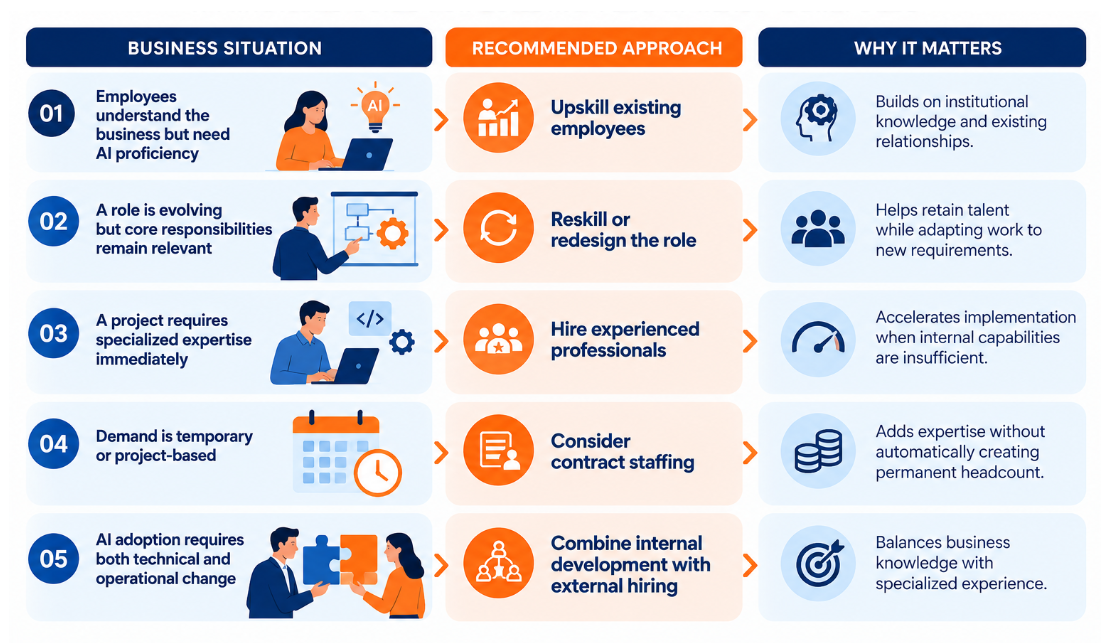
One of the most important decisions facing business leaders is whether to develop existing employees or bring in external talent.
There is no universal answer. The right approach depends on the skills required, the time available, the cost of development, and the level of expertise the organization needs.
When reskilling makes sense
Reskilling is particularly valuable when employees already understand the company’s processes, customers, systems, or compliance requirements.
Consider a financial services company introducing AI-assisted document processing. Its existing operations team may understand the documentation, exception handling, customer requirements, and internal controls. With appropriate training, some employees may transition toward exception management, output validation, process improvement, and AI-supported operations.
The organization can retain valuable business knowledge while developing capabilities that support the new operating model.
However, reskilling should be based on realistic assessments. Not every employee will be suited to every emerging role, and training alone cannot replace the experience required for highly specialized technical work.
When external hiring makes sense
Hiring is often the better option when a business needs expertise that it does not currently possess, particularly when implementation timelines are tight.
A company deploying a new AI-enabled platform may need experienced AI engineers, cloud specialists, cybersecurity professionals, or data architects. Building these capabilities entirely from within could delay the initiative.
External hiring can also introduce new approaches and help internal teams learn from experienced practitioners.
The objective should not be to choose between reskilling and recruitment as competing strategies. It should be to identify the right combination for each capability gap.
4. Why Workforce Planning Must Start Before AI Implementation
Many organizations begin workforce discussions after selecting a technology platform or launching an AI pilot. By then, they may already have made assumptions about team structures, budgets, and implementation timelines.
A stronger approach begins workforce planning alongside technology planning.
McKinsey’s March 2025 global AI survey found that more than three-quarters of respondents said their organizations used AI in at least one business function. Yet only 21% of respondents whose organizations used generative AI reported that their organizations had fundamentally redesigned at least some workflows. The survey also found that workflow redesign was strongly associated with reported bottom-line impact from generative AI. These are survey findings, not a guarantee of financial returns for individual businesses.
This distinction matters because introducing AI into an existing process does not automatically create a more effective operating model.
If an organization automates one task without reconsidering the surrounding workflow, employees may still spend time transferring information between systems, correcting errors, reviewing unnecessary steps, or managing exceptions manually.
Workforce planning helps leaders understand how responsibilities should change alongside the technology.
For example, before implementing an AI-supported customer service system, a business should assess which inquiries can be handled automatically, which require human judgment, how complex cases will be escalated, and what employees need to learn to manage the new process.
This makes it possible to plan training, staffing levels, role changes, and specialist hiring before the technology is fully deployed.
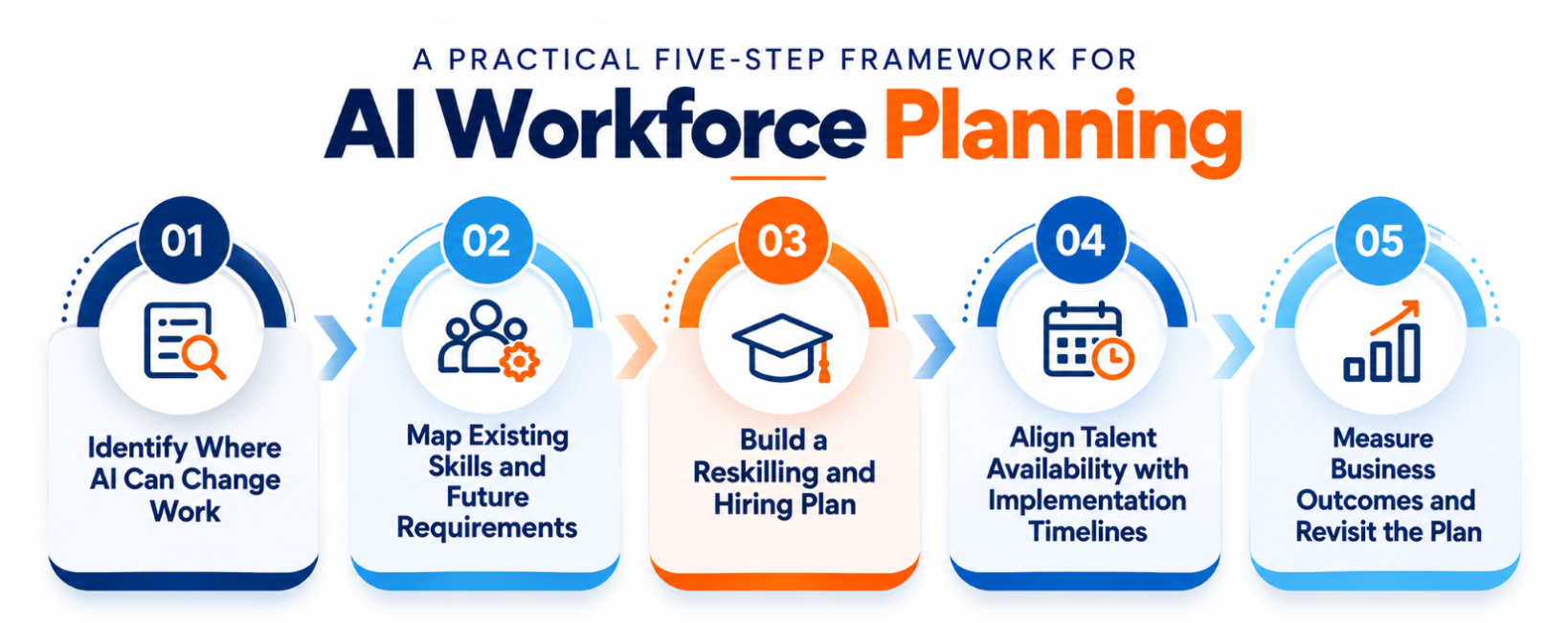
5. A Practical Five-Step Framework for AI Workforce Planning
Businesses do not need to predict every future job title to prepare for AI-driven change. They need a structured process for identifying skill gaps and making informed workforce decisions.
Step 1: Identify Where AI Can Change Work
Review business processes across technology, finance, HR, customer service, sales, and operations. Identify repetitive tasks, bottlenecks, and areas where AI could improve productivity or decision-making.
Step 2: Map Existing Skills and Future Requirements
Assess the capabilities of your current workforce and compare them with the skills required for AI-enabled workflows. Consider technical expertise, business knowledge, analytical ability, and readiness to adopt new tools.
Step 3: Build a Reskilling and Hiring Plan
Determine which employees can be trained, which roles need to evolve, and where external recruitment is necessary. Prioritize decisions based on business impact, urgency, and the time required to develop each capability.
Step 4: Align Talent Availability with Implementation Timelines
Identify when specific skills will be needed and how quickly they can be developed or recruited. Consider permanent hiring for long-term needs and contract staffing for specialized projects or temporary capacity gaps.
Step 5: Measure Business Outcomes and Revisit the Plan
Track whether AI initiatives improve productivity, quality, turnaround times, service levels, or operating costs. Reassess workforce requirements as technology, business priorities, and employee capabilities evolve.
This approach makes workforce planning an ongoing business process rather than a one-time staffing exercise.
6. The Role of Flexible Staffing in an AI-Driven Workforce
AI implementation does not always follow a predictable hiring cycle. A business may need a data engineer for a defined integration project, cybersecurity expertise during deployment, or additional software development capacity while modernizing an application.
Hiring permanent employees for every temporary requirement may not be the most practical approach. At the same time, relying entirely on short-term contractors may not provide the continuity needed for long-term AI operations.
A flexible workforce strategy allows organizations to align talent decisions with the nature of the work.
Permanent hiring can support capabilities that are central to the business over the long term, including AI governance, core software engineering, data management, and ongoing technology operations.
Contract staffing can help organizations access specialized expertise for implementation, integration, testing, data migration, and other time-bound requirements.
Contract-to-hire arrangements, where appropriate, can provide an opportunity to evaluate the fit between a professional and the organization’s longer-term needs.
Staff augmentation can help internal teams manage additional project workloads without requiring the organization to source every specialized skill through permanent recruitment.
The appropriate model depends on the role, project duration, budget, management requirements, and expected future demand.
For workforce leaders, the objective is to balance speed, capability, cost, and continuity rather than relying on a single hiring model.
7. The Human Side of AI: Change Management and Employee Trust
Even a technically successful AI implementation can struggle if employees do not understand how it will affect their work.
Employees may have concerns about job security, performance expectations, data privacy, or whether they will receive the training needed to use new tools effectively. These concerns can influence adoption and the quality of implementation.
Business leaders should communicate the purpose of AI initiatives clearly, explain how responsibilities may change, and provide opportunities for employees to develop relevant skills.
Training should also be role-specific. A software engineer may require advanced technical instruction, while a recruiter may need guidance on responsible AI use, evaluating generated content, and maintaining human judgment in candidate assessment.
Organizations should establish clear expectations for human review, data handling, accountability, and escalation when AI produces inaccurate or inappropriate results.
McKinsey’s 2025 survey identified risks involving inaccuracy, cybersecurity, and intellectual property among the concerns organizations are managing as they expand generative AI use.
Workforce readiness therefore involves more than technical training. It also requires communication, governance, leadership support, and a clear understanding of how employees will contribute to the new operating model.
8. What Business Leaders Should Do Now
For CHROs, CIOs, COOs, and talent acquisition leaders, the next step is to translate AI ambitions into specific workforce decisions.
Start by asking five questions:
- Which business processes will change first? Prioritize workflows where AI could address a clearly defined business problem.
- Which skills will become more important? Consider technical capabilities alongside analytical thinking, judgment, communication, and risk management.
- What can the current workforce take on? Identify employees who can be upskilled, reskilled, or redeployed.
- Where is external talent necessary? Determine which capability gaps require immediate recruitment or temporary specialist support.
- How will success be measured? Connect workforce decisions to business outcomes, not simply the number of people trained or hired.
These questions can help organizations avoid reactive recruitment, unnecessary restructuring, and training programs that are disconnected from actual business needs.
The most effective workforce plans will be those that evolve as AI capabilities, organizational priorities, and skill requirements change.
Building the Workforce Behind AI Transformation
AI is changing the skills businesses need, the way employees perform their jobs, and how organizations approach talent acquisition. But technology adoption alone does not guarantee better business outcomes.
Companies must understand how their workflows will change, identify the capabilities required to support those changes, and determine the right balance between developing existing employees and bringing in new talent.
For some organizations, that may mean investing in reskilling. For others, it may require specialist hiring, contract staffing, or a combination of workforce models that supports both immediate implementation and long-term capability building.
The goal is not to predict every future role perfectly. It is to build a workforce strategy that can adapt as business requirements evolve.
At Abacus Service Corporation, we understand that workforce planning requires more than filling open positions. It requires aligning talent with business priorities, changing skill requirements, and evolving operating models.
Through flexible staffing and talent solutions, organizations can access the capabilities they need to support technology initiatives, strengthen existing teams, and respond to changing workforce demands.
As businesses move from AI experimentation to broader implementation, the organizations best positioned for success will be those that plan for the people side of transformation as carefully as they plan for the technology.
Ready to align your workforce strategy with your business’s evolving technology needs? Connect with Abacus Service Corporation to explore talent solutions that support your workforce priorities.
Sources used
U.S. Bureau of Labor Statistics, Artificial intelligence, information technology, and employment, 2024–34 — current U.S. occupational projections.
World Economic Forum, The Future of Jobs Report 2025 — global workforce and skills projections through 2030.
McKinsey, The state of AI: How organizations are rewiring to capture value (March 2025) — AI adoption, workflow redesign, and implementation risks.